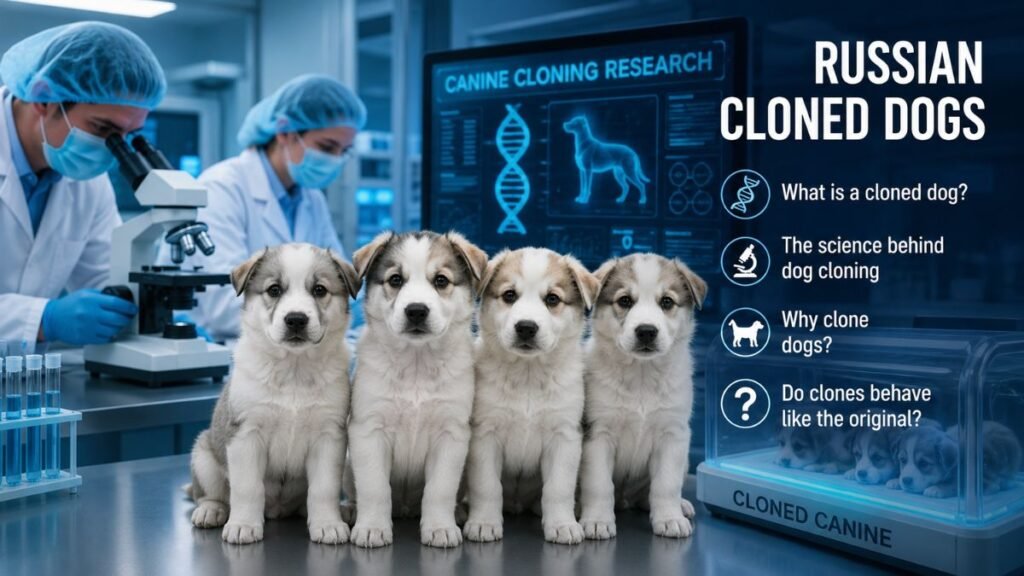
The idea of Russian cloned dogs may sound like something from a science-fiction movie, but dog cloning is a real scientific technology. Researchers have successfully produced cloned dogs, and Russia has also been connected with projects involving cloned dogs, particularly the preservation of rare working breeds.
But what exactly is a cloned dog? Why would scientists clone a dog? And does a clone behave exactly like the original animal?
These questions are becoming more interesting as cloning technology develops. In this guide, we will look at Russian cloned dogs, the science behind dog cloning, its possible uses, and some of the important questions surrounding the technology.
What Are Russian Cloned Dogs?
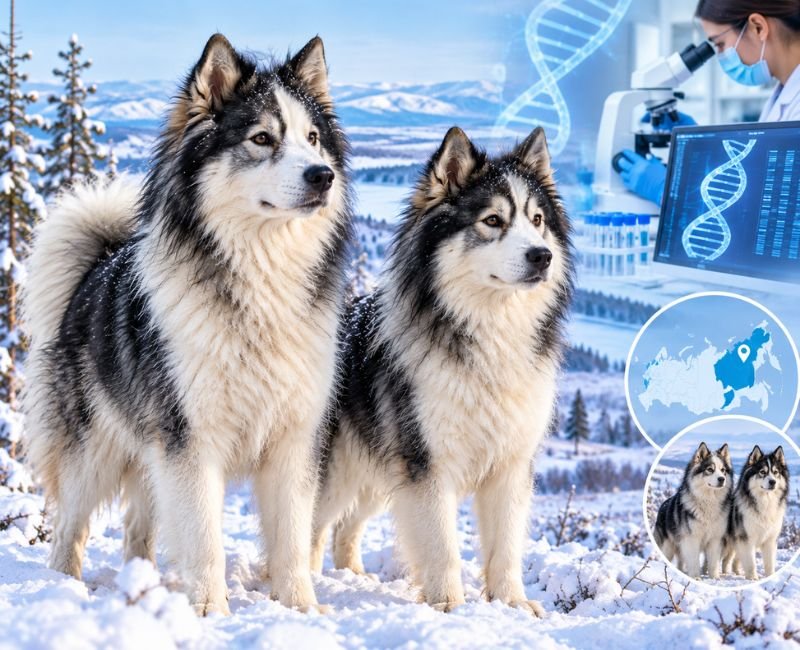
The term Russian cloned dogs generally refers to cloned dogs connected with research or conservation projects in Russia.
One notable example involves the Yakutian Laika, a traditional hunting dog from Yakutia in northeastern Russia. The breed had become extremely rare, and researchers and local enthusiasts became interested in using modern reproductive technology as part of efforts to preserve it.
Two cloned Yakutian Laikas, Kerecheene and Beleh, were produced through a collaboration involving the North-Eastern Federal University in Yakutia and South Korean researchers. The cloning itself was carried out in South Korea using genetic material from purebred dogs.
This is an important distinction: these were not simply dogs cloned entirely inside Russia. They were part of an international scientific project connected to the preservation of a rare Russian-region dog breed.
Why Are Dogs Cloned?
Dog cloning can have several possible purposes.
One reason is research. Scientists can use cloned animals to study genetics, reproduction, inherited diseases, and other biological questions.
Another reason is the preservation of valuable genetic material. If a rare animal has desirable characteristics, researchers may investigate whether cloning could help preserve some of its genetic traits.
For endangered or nearly lost dog populations, cloning may also be considered as one tool among many conservation methods.
However, cloning is not a simple replacement for traditional breeding. A cloned dog still needs to grow, learn, socialize, and develop in its own environment.
How Does Dog Cloning Work?
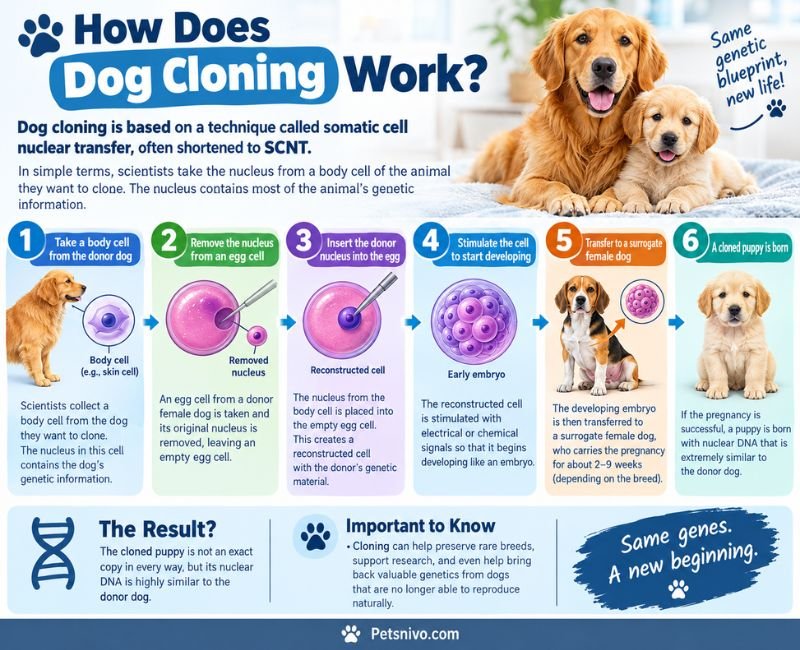
Dog cloning is based on a technique called somatic cell nuclear transfer, often shortened to SCNT.
In simple terms, scientists take the nucleus from a body cell of the animal they want to clone. The nucleus contains most of the animal’s genetic information.
That nucleus is placed into an egg cell whose original nucleus has been removed. Scientists then stimulate the reconstructed cell so that it begins developing like an embryo.
The embryo can eventually be transferred to a surrogate female dog.
If the pregnancy is successful, a puppy is born with nuclear DNA that is extremely similar to the donor animal.
This sounds straightforward when explained in a few sentences, but the actual process is technically difficult. Dog reproduction has biological challenges that make cloning more complicated than it may appear.
Are Cloned Dogs Exactly the Same as the Original?
Not exactly.
A cloned dog can have almost the same nuclear genetic information as the donor, but genetics is only one part of what makes an individual dog unique.
Environment, training, nutrition, social experiences, and other biological factors can influence how a dog develops.
Think about identical twins in humans. They can have very similar genetic information but still have different personalities, preferences, and life experiences.
The same basic idea applies to cloned dogs.
A cloned dog may resemble the original animal, but it should not be expected to have exactly the same personality or behavior.
The Story of the Yakutian Laika Clones
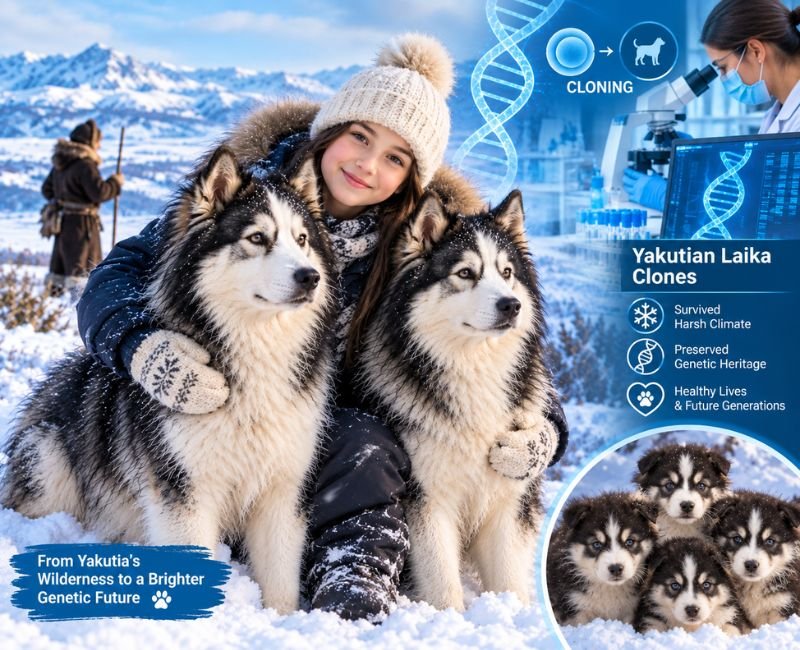
The Yakutian Laika is especially interesting when discussing Russian cloned dogs.
This traditional hunting breed is associated with Yakutia’s harsh environment. During the 20th century, the population suffered major losses, including from disease.
Researchers and local dog enthusiasts became interested in preserving the breed and studying its genetic characteristics.
The cloning project involving Kerecheene and Beleh was part of this wider effort. Recent reports said the cloned dogs reached nine years of age and lived in normal kennel conditions. One of the dogs also produced puppies, providing researchers with another interesting opportunity to observe the animals and their descendants.
This example shows that cloning can be discussed not only as a way of copying an individual pet but also as a possible conservation tool.
What Can Cloning Tell Scientists?
Cloned dogs can help scientists understand several areas of biology.
Researchers can compare cloned animals with their genetic donors and study how similar or different they become over time.
Studies of cloned dogs have also examined health and longevity. Research involving Snuppy, the first widely recognized cloned dog, found that Snuppy and his cell donor had lifespans that were relatively close to the expected lifespan for Afghan Hounds.
Another scientific study examined the genomes of cloned and donor dogs and found very high genetic similarity while also highlighting the role of factors beyond nuclear DNA in differences between animals.
These studies are useful because they help scientists understand what cloning can and cannot reproduce.
Does Cloning Create a Perfect Copy?

No.
This is one of the biggest misunderstandings about cloning.
A clone is not a time machine, and it does not bring an old dog back to life. Instead, cloning creates a new animal using genetic material from another animal.
The new puppy begins its own life.
It will experience a different environment, meet different people, receive different training, and develop its own habits.
Even its appearance may not be perfectly identical to the donor.
For dog owners, this distinction is very important. Someone who chooses cloning because they miss a particular dog should understand that the resulting animal is genetically related to the original, but it is still a new individual.
Potential Benefits of Dog Cloning
There are several reasons scientists are interested in cloning technology.
Preserving Rare Genetics
When a rare breed has a very small population, genetic preservation can become important. Cloning may provide researchers with another way to preserve genetic material from valuable animals.
Scientific Research
Cloned dogs can provide useful models for studying genetics, reproduction, inherited diseases, and other biological questions.
Supporting Conservation
In certain situations, cloning could potentially complement traditional conservation and breeding programs.
The Yakutian Laika project is an example of how cloning has been discussed in connection with preserving a rare working breed.
Challenges and Ethical Questions

Despite its potential, dog cloning also raises difficult questions.
One major concern is animal welfare. Cloning can involve multiple reproductive procedures, and not every attempt results in a successful pregnancy or healthy puppy.
There are also questions about whether cloning should be used primarily for scientific research, conservation, or commercial pet replacement.
Another concern is cost. Pet cloning has historically been an expensive service, making it unavailable to most dog owners. Veterinary organizations and animal-welfare discussions have also raised questions about whether spending large amounts on cloning is preferable to supporting animals that already need homes.
These questions do not have simple answers. They involve science, animal welfare, personal choices, and conservation priorities.
Russian Cloned Dogs and the Future of Cloning
The future of dog cloning will likely depend on scientific progress, animal-welfare standards, and how society chooses to use the technology.
Russia’s connection with cloned dogs is particularly interesting because some projects have focused on rare working breeds rather than simply creating copies of popular pets.
The Yakutian Laika example demonstrates how researchers can combine modern biotechnology with efforts to preserve traditional animal populations.
At the same time, cloning should not be viewed as a replacement for responsible breeding, veterinary care, habitat protection, or broader conservation programs.
Those methods remain important for maintaining healthy dog populations.
Frequently Asked Questions
1. What are Russian cloned dogs?
Russian cloned dogs are cloned dogs connected with scientific, conservation, or research projects involving Russia. The Yakutian Laika cloning project is one notable example.
2. Are cloned dogs genetically identical?
A cloned dog has extremely similar nuclear DNA to its donor, but that does not mean it will have exactly the same appearance, personality, or behavior.
3. Can a cloned dog have puppies?
Yes. Cloned dogs can reproduce. Research has documented reproduction involving cloned dogs and their offspring.
4. Why was the Yakutian Laika cloned?
The project was connected with efforts to preserve and revive a rare traditional hunting breed from Yakutia.
5. Is cloning the same as bringing a dead dog back?
No. Cloning creates a new animal using genetic material from another animal. It does not bring the original dog’s individual life or memories back.
Final Thoughts
Russian cloned dogs represent an interesting meeting point between modern biotechnology and traditional dog conservation.
The story of the cloned Yakutian Laikas shows that cloning can have purposes beyond creating copies of beloved pets. Scientists and conservationists can explore the technology as one possible way to preserve valuable genetic characteristics in rare animal populations.
However, cloning has clear limitations. A cloned dog is a new individual, not the original animal returned to life. Genetics can be copied to a remarkable degree, but personality, experiences, training, and environment cannot simply be duplicated.